Home → Workflow → Review & BREX
Review & BREX
Every DM cycles through some form of review before it ships. Ironmark holds three surfaces for that: per-document IPRFs, project-wide BREX validation, and a cross-project review queue.
In-Process Review Form (IPRF)
Per-document, per-cycle. Open a review, assign reviewers (or leave open for self-select), reviewers walk sections with per-item accept / accept-with-change / reject decisions plus comments. Aggregate closes to a single outcome. Approved status can auto-bump the S1000D issueNumber if the project opts in.
Peer-review self-guard
A document's own author can't peer-review their own work — enforced at the content level, not just via UI. An author who wears both roles on different projects still can't approve a DM they authored. Prevents self-approval by accident.
BREX validation
Business Rules Exchange encodes program-local restrictions on top of the schema. Ironmark ships the structural rule shape scaffolded from the SDM and lets non-structural rules author through widgets — allowed-value lists, required attributes, cardinality, forbidden children. Rules that fall outside the widget set live as XPath in the project's BREX DM; the editor round-trips both.
Where BREX runs
- In the editor — on-save validation surfaces rule violations inline. Quick-fix widgets attach a one-click repair when the rule declares a
widget-kind. - In the IPRF — reviewers see BREX diagnostics alongside their comments. Quality debt is visible without leaving the review.
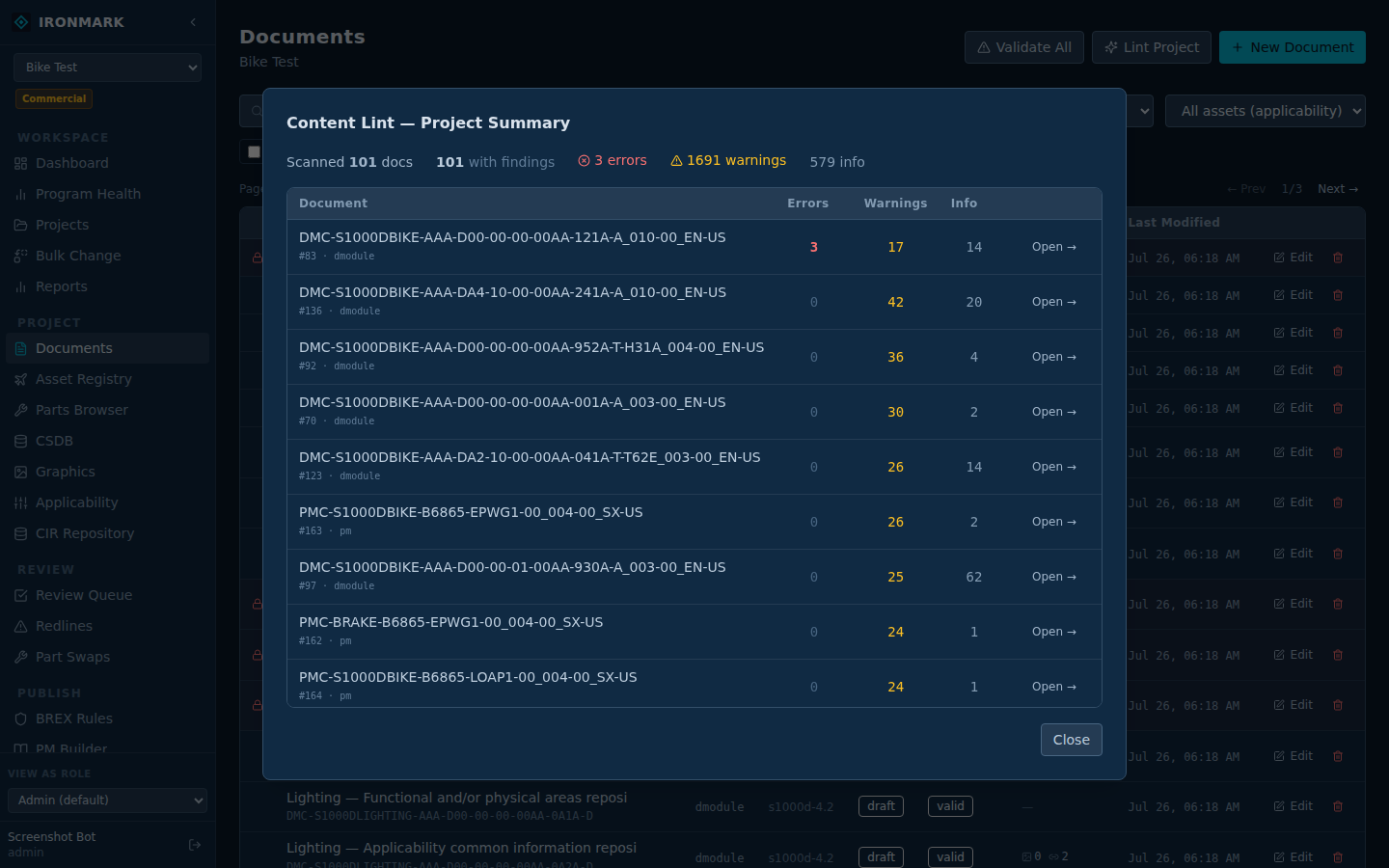
- Project-wide summary — the BREX page runs every DM against the rule set and lists top-firing rules. Useful before a release cut.
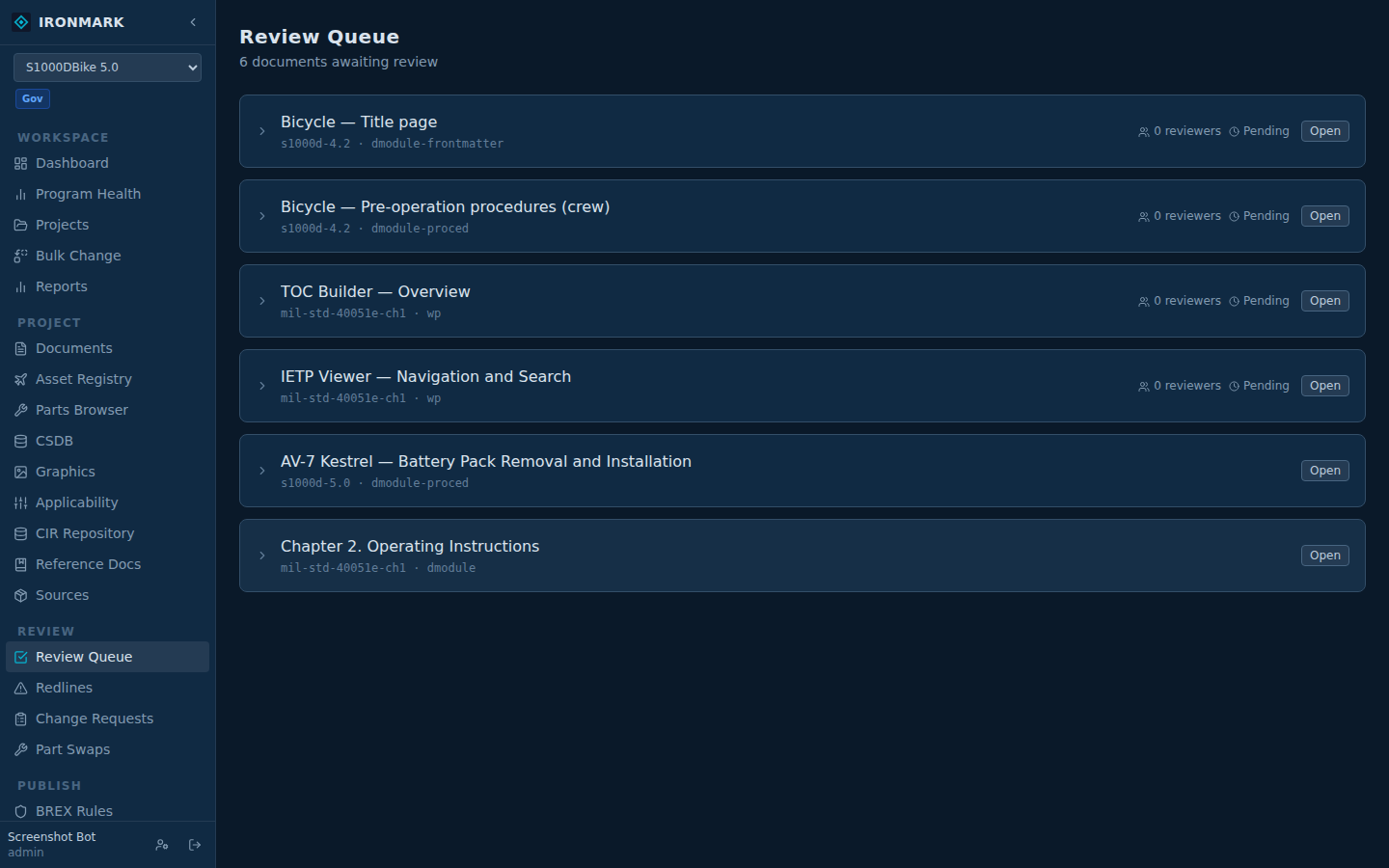
Review queue
Left nav → REVIEW → Review Queue. Shows every open review across the projects the user has access to (with an optional single-project filter). Filter by reviewer, assignee, workflow state. QA leads use it to see what's blocked; peer reviewers use it to pull work.
dmRef targets, missing CIR entries. One-click fix actions where the resolution is deterministic.Change requests + redlines
Two more surfaces feed the review flow:
- Change Requests — first-class entities that track a proposed change end-to-end. Author raises, QA triages, disposition + implementation lands on the DM.
- Redlines — line-level markups on a DM, filed by customers via the portal or by internal reviewers. Redlines link to the source DM's current cycle.
Notifications
Per-user preferences control email on review-assigned, comment-added, and approval. Portal customers get separate notification settings for feedback triage. All notification pipelines respect the project's user membership — nobody gets emailed about a project they aren't on.