Publishing
Publishing turns the project's DMs into whatever the delivery target expects — PDF for print or portal delivery, IADS for the IETM viewer, HTML for the built-in IETP surface. All three read from the same source-of-record modules; no separate copy of the content lives in the publish pipeline.
PDF backends
| WeasyPrint | HTML + CSS Paged Media. The default for projects that don't need XSL-FO. Fast, deterministic, ships bundled. |
| Apache FOP | Optional external XSL-FO engine — installed via install.sh --with-fop or apt install fop. Solid FO-spec coverage; good pick when a program already has FOP-tuned XSL-FO stylesheets. |
| ironmarkpdf | Ironmark's XSL-FO renderer. Bundled. Purpose-built for the SDM-shipped stylesheets and their edge cases. |
| Antenna House | Third-party — licensed separately from Ironmark, purchased directly from AH. Programs on an existing AH license can point Ironmark at their AH installation via the publishing settings. |
| RenderX XEP | Third-party — licensed separately from Ironmark, purchased directly from RenderX. Customer-configured, same shape as Antenna House. |
Per-SDM stylesheet lives with the SDM; per-project overrides let you swap logos, cover pages, and section-level formatting without editing the SDM.
IADS packaging
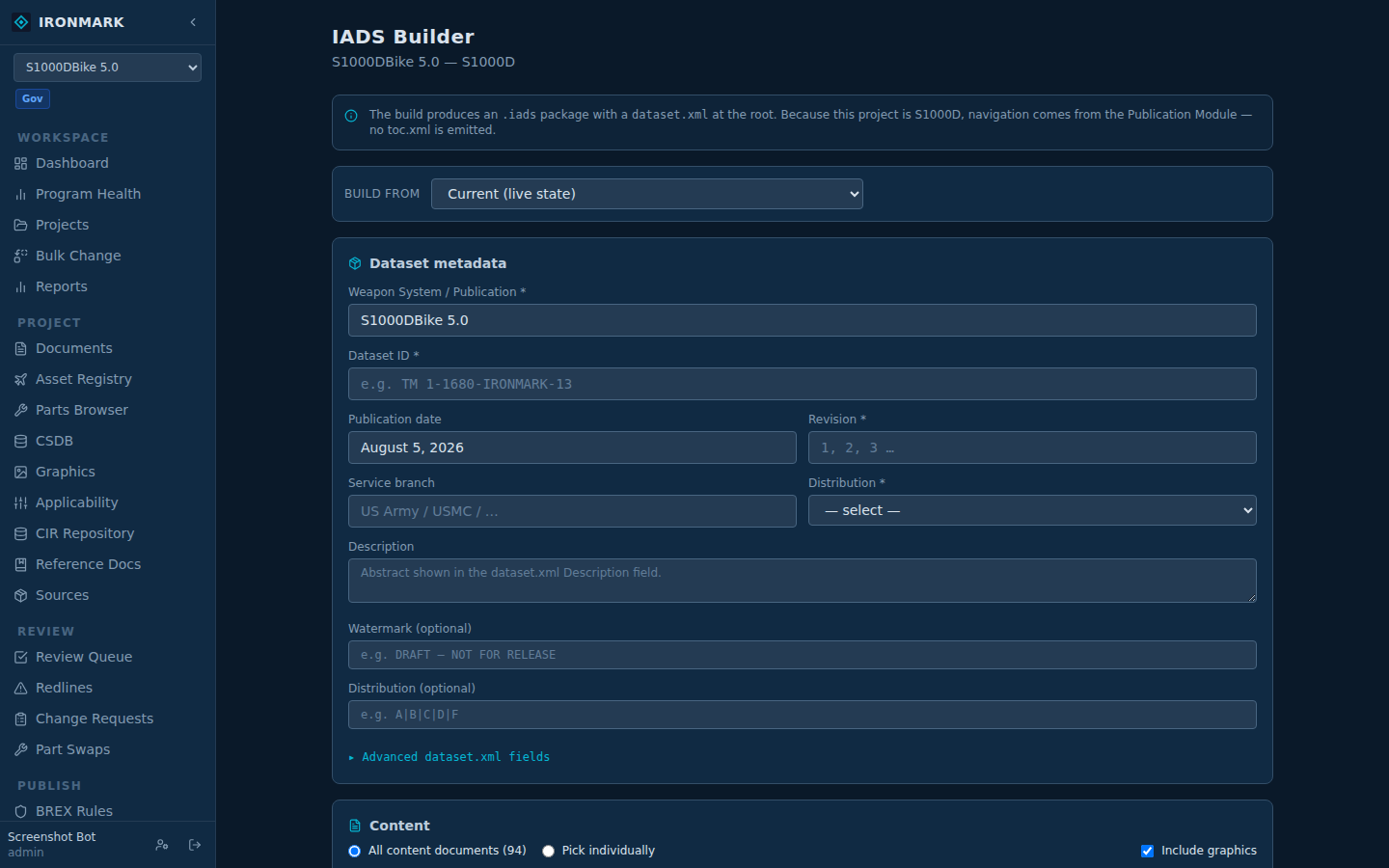
IADS export builds a delivery package the IADS viewer opens directly. Key properties:
- Source dataset preserved — the imported IADS's source dataset survives round-trip. Editing DMs in Ironmark doesn't blow away structure IADS relies on.
- DTD folder retained — if the project holds a customer-supplied DTD variant (see Import an IADS package), it goes back out in the package.
- TOC filename plan — the TOC XML gets the customer-conventional filename per SDM, not a generic default.
- ICN handling — cross-project ICNs are namespaced so a shared filename between two projects doesn't collide in the package.
Combined IADS across a TM Family
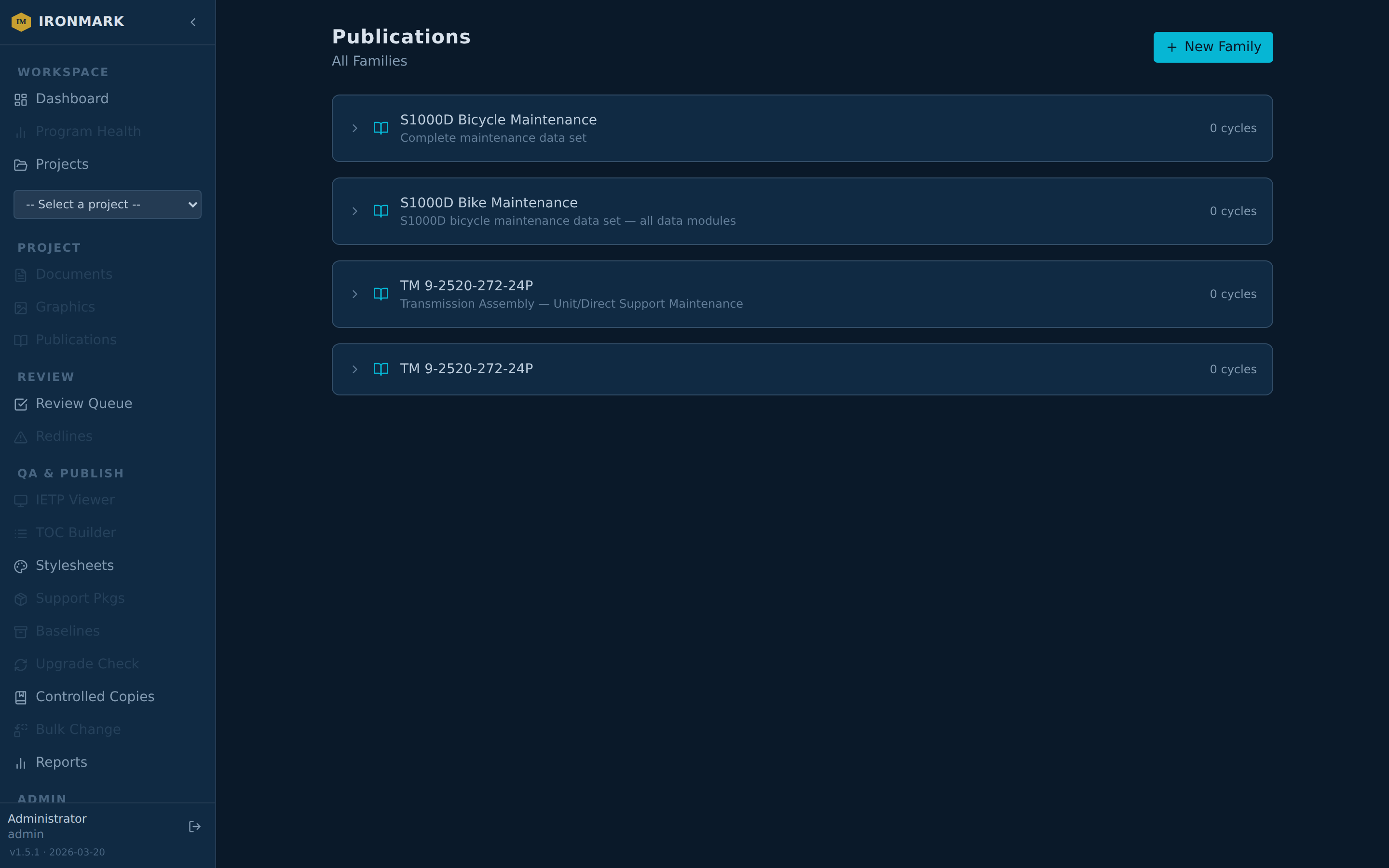
Family-scoped publish produces a single combined IADS containing every project in the family. Same standard required across all members — mixed 40051 + S1000D families are rejected at publish time with a clear diagnostic; use the ZIP delivery for mixed families.
In-tool preview
Ironmark renders a browser preview of a DM directly from the source-of-record, so authors and QA can inspect the same content the publish pipeline sees without producing a full package. This is a development preview, not a delivery viewer — customers open the finished deliverable in whatever IETP viewer their program has standardized on.
Portal delivery
Every program ships with a portal — customer-facing surface where a reader browses / searches / filters / downloads the published TM without an authoring seat. Redlines feed back into the review workflow. Portal auth is separate from author auth so customer identity doesn't sit in the author IdP.