Home → Architecture → Baselines
Document baselines & version comparison
Name the document versions that defined a project state, then compare later work against them.
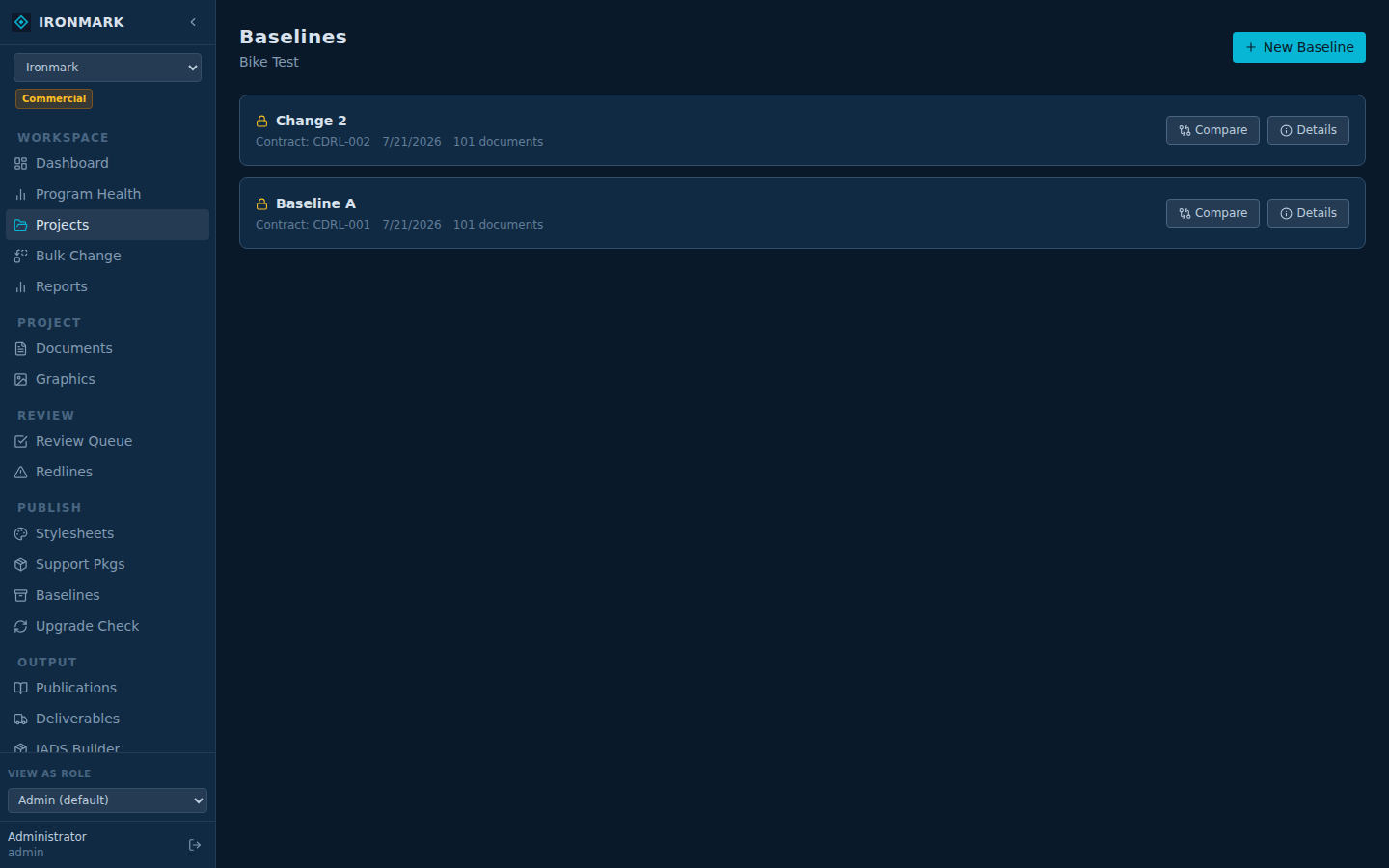
An Ironmark project baseline is a named, locked set of document ids and version numbers captured at a point in time. It supports historical document comparison, change-bar reference selection, and baseline-aware export paths. It is not currently a complete image of every project table, external formatter, stylesheet, graphic, or runtime dependency.
What a baseline is
A baseline records a name, description, optional contract reference, creator, timestamp, locked state, and one entry for each project document at its recorded version number. The referenced document versions remain available for supported comparisons and exports while the project continues to change.
What is captured
Content
- Baseline name, description, contract reference, creator, and timestamp
- Each document id in the project
- The recorded version number for each document
- A locked flag for the baseline record
Supported uses
- Compare a baseline with current document versions
- Compare two baselines within the same project
- Select baseline versions for supported change-bar workflows
- Use frozen XML document versions in supported IADS export paths
What is not captured
The current baseline record is intentionally narrower than a complete archival package. Unless separately preserved by the customer's release and records process, it does not itself freeze:
- graphics and other filesystem assets;
- IPD catalog rows, applicability tables, BREX rules, or CIR records as independent database snapshots;
- SDM packages, customer DTDs, stylesheets, project overrides, or formatter binaries;
- external-system state, portal identities, sessions, or runtime state;
- a complete environment capable of reproducing an earlier PDF byte-for-byte.
When to create one
- Release candidate — identify the document versions reviewed for a delivery.
- Regulatory milestone — associate a named document-version set with customer acceptance, CDRL delivery, or another review date.
- Before a large refactor or migration — retain a comparison point for the documents included in the project.
- Scheduled checkpoint — long-running programs may choose periodic baselines between releases.
How baselines support audits
A historical review often asks which document versions were associated with a named project state. Baselines provide that document-version index and the supported comparisons below; they do not independently reconstruct uncaptured project tables or the complete release environment.
- Inspect the baseline — view its recorded documents and version numbers.
- Compare with current — identify added, removed, modified, and unchanged documents.
- Compare two baselines — obtain the supported same-project JSON document comparison.
- Export supported content — select recorded XML versions in baseline-aware IADS export workflows.
How baselines support long-term sustainment
Defense and aerospace programs measure lifecycle in decades. The people who authored the manual will not be the people who revise it. The tool the manual was authored in will have moved several major versions. The published output will need to be reproducible when a specific part swap needs to be applied against exactly the manual state that shipped in 2029.
Baselines provide a durable index into document history. Long-term reproducibility still requires an independent release archive containing the delivered artifact, source package, graphics, schemas/DTDs, stylesheets, formatter identity, Ironmark version, and any external dependencies required by the program.
- Document-version references — retain the project document set selected at cut time.
- Change comparison — show how current document versions differ from the recorded set.
- Release context — store a name, description, and contract reference alongside that set.
Records management is still your responsibility
Ironmark maintains published deliverables as part of the publication history. However, organizations should continue following their established records management and archival policies. We recommend maintaining an independent archive of released deliverables in accordance with your organization's retention requirements.